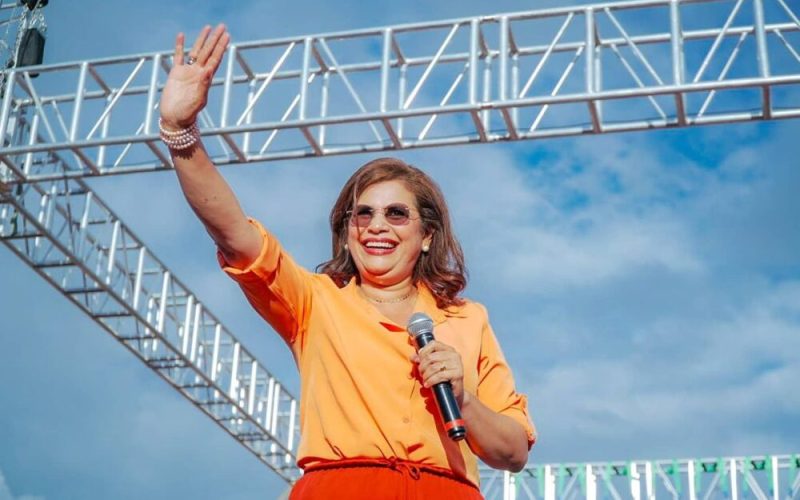
With only a few weeks remaining until the general elections, presidential hopeful Rixi Moncada is currently facing a phase of political and economic erosion, which is affecting the stability of the governing party. Her communication approach, marked by an adversarial stance against private businesses and the banking sector, has caused apprehension within the productive sphere and among a significant portion of the populace.
Industry Response and Market Indicators
The business community has increasingly distanced itself from what some perceive as an unfavorable climate for investment. Spokespersons for various industries highlighted that the candidate’s rhetoric has resulted in the paralysis of projects and the removal of capital from several regions nationwide. A textile industry executive commented that their firm chose to halt operations, stating, «you cannot invest where you are treated as an adversary.»
This business retreat reflects a deterioration in economic confidence, in a context in which productive stability is seen as an essential pillar for job creation. Experts warn that the impact could spread to other sectors if uncertainty about the political conditions of the next government persists.
Public perception and electoral fatigue
Within the social realm, the response has been equally notable. Different segments of the populace have voiced their disapproval of the hostile nature of political rhetoric, popularizing the hashtag #NoQueremosOdio (We don’t want hate) across social media platforms. This expression encapsulates a pervasive sense of weariness regarding conflict and the absence of tangible policy suggestions.
Recent polls show a significant drop in voting intentions for Moncada, particularly among young people, women, and private sector workers. Political communication analysts interpret this trend as the result of a disconnect between the campaign message and the expectations of an electorate seeking certainty and tangible solutions. One of them pointed out that the candidate “has simultaneously weakened her relationship with the country’s economic engine and with the electorate that demands moderation.”
Political ramifications for LIBRE
The ramifications of this scenario go beyond Rixi Moncada as an individual and affect the LIBRE party, which is experiencing both internal and external pressure to adjust its electoral approach. To date, the leadership has not commented on their candidate’s diminishing support, and speculation is mounting regarding a potential substitution prior to the conclusion of the electoral cycle.
The challenge for LIBRE is to preserve party cohesion and avoid a leadership vacuum that could affect its institutional negotiating capacity. In a scenario of growing polarization, the deterioration of business and social confidence could condition governance after the elections.
A changing landscape
The campaign’s progression will dictate if the candidate succeeds in mending her relationships with the economic and social groups that currently seem disengaged. With the election drawing nearer, the governing party is challenged to showcase its ability for communication and steadiness to an increasingly discerning voter base.
Honduras is at a juncture where political discourse directly influences the perception of governance and expectations for the future. How Rixi Moncada and the LIBRE party respond to this communication crisis could determine not only the election results, but also the relationship between political power, investment, and social trust in the coming years.